

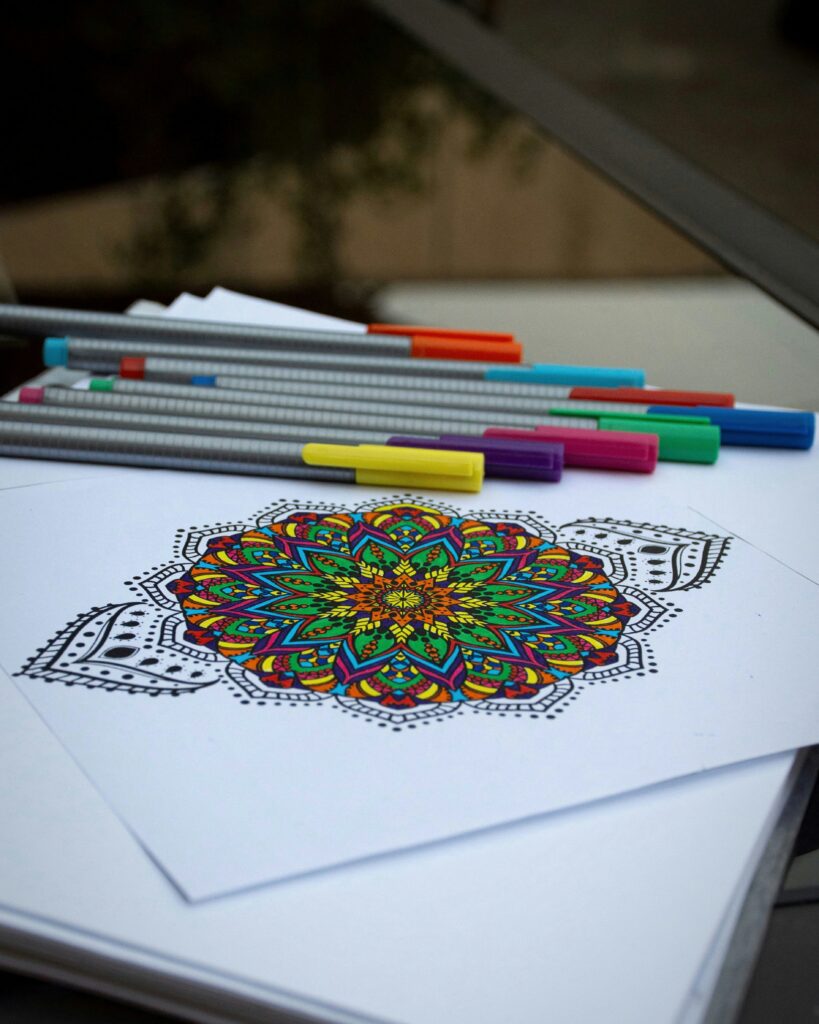
Christmas Coloring to Reduce Anxiety and Festive Stress
The run-up to Christmas is often described as “the most wonderful time of the year”. In practice, it can also be one of the most demanding. Extra social plans, family expectations, financial pressure, busier workplaces and disrupted routines all compete for attention. Mental health organisations note that many people experience increased stress, anxiety and low mood around Christmas and the holiday period. Mental Health Foundation+2Mind+2
Adult Christmas coloring offers a small, practical way to carve out calm in the middle of that noise. It does not solve every source of stress, but it can give your brain and body a short, predictable break from constant demands.
Why coloring is calming for adults
Coloring combines several elements that research links with reduced stress and improved emotional regulation:
- repetitive, rhythmic hand movements
- focused attention on a simple task
- limited, non-demanding choices (which color, which section next)
- a clear, low-pressure end point (finishing a page or a small part of it)
Health organisations describe coluring as a “healthy way to relieve stress” that can calm the brain and help the body relax. Mayo Clinic Health System notes that coloring can lower heart rate and respiration and may reduce feelings of anxiety and depression. Mayo Clinic Health System
Research on adult coloring books has also found measurable mental health benefits. A study of adults using coloring books for brief daily sessions reported significant reductions in symptoms of anxiety and depression compared with a control group. Taylor & Francis Online A separate study exploring how coluring influences mood and stress found that structured coloring activities were associated with decreased stress and negative affect and increased relaxation. jiss.org
These findings fit into a wider body of evidence on art-making and mental health. Reviews of art therapy in adults suggest that creative, visual activities can support stress regulation and emotion regulation, and may be a useful component of treatment for anxiety. PMC+1
In short, when you sit down with a coloring page, you are not “just coloring in”. You are giving your attention a narrow, gentle focus and letting your nervous system shift into a calmer state.
Why Christmas-themed pages work especially well
Christmas and winter imagery can add an extra layer of comfort to the basic benefits of coloring:
- Familiar motifs such as baubles, snowflakes, trees and stars can feel soothing because they are linked with long-established seasonal memories.
- Repeating patterns (garlands, knitted textures, decorations) are ideal for slow, rhythmic coloring that does not demand complex decisions.
- Warm, rich coloring palettes – deep reds, greens, golds and candlelight tones – naturally suggest cosiness and evening relaxation.
Mental health charities emphasise that one way to protect your wellbeing at Christmas is to keep up activities and hobbies you enjoy, but adapt them to the season – for example by turning existing creative interests into festive versions. Mental Health Foundation+1 Christmas coloring pages do exactly that: they take a simple, creative habit and wrap it in seasonal imagery.
Turning Christmas coloring into a “quiet night” ritual
To get the most benefit, it helps to treat coloring as a small ritual rather than something you squeeze into leftover time. A short, consistent practice can signal to your brain that it is safe to slow down.
A simple evening routine might look like this:
- Set a clear time boundary
Decide in advance that you will color for, for example, 10–20 minutes after dinner or before bed. Knowing there is an end point can make it easier to start. - Reduce competing stimulation
Put your phone on silent or in another room. Switch from bright overhead lighting to a softer lamp if possible. This mirrors advice from sleep and mindfulness resources, which highlight the value of reducing digital stimulation and harsh light before bedtime. Headspace - Choose one page and a limited palette
Pick a single Christmas image and three to five colors. Limiting choices reduces decision fatigue, which is often heightened during busy periods. - Pair coloring with a calming cue
You might make herbal tea, play gentle instrumental music or light a (safe) candle. Over time, your brain can start to associate these cues with winding down. - Focus on process, not perfection
The goal is not a flawless finished page. It is the act of moving color across paper, section by section. If you notice your mind jumping to to-do lists, simply return attention to the area you are coloring and the movement of your hand.
This kind of small, predictable ritual can create a psychological “buffer” between the busyness of the day and sleep, particularly during a season when evenings can easily be filled with screens and last-minute tasks.
Using coloring to ease festive overwhelm, not add to it
Holiday wellbeing advice often centres on boundaries, planning and saying no to unnecessary commitments. Adult Christmas coluring can support those principles in a few practical ways:
- A reason to pause
Scheduling 10–20 minutes of quiet coloring gives you a concrete activity that justifies taking a break: “I have something planned for myself this evening.” - A gentle way to step out of social situations
If gatherings feel intense, taking a short break to sit at the table and color can be less abrupt than disappearing to another room, while still giving your nervous system time to settle. - A screen-free alternative when you are tired
When energy is low, it is easy to default to scrolling. Coloring offers a low-effort option that does not involve more information, news or comparison. - A shared, low-pressure activity
You can also invite a partner, friend or family member to color alongside you. Because coloring does not demand constant conversation, it can create a calm kind of togetherness where talking is optional.
The key is to let coloring simplify your evenings, not complicate them. You do not need to finish a full page each time or track your progress. A few colored baubles or a partially shaded wreath are enough for that session to “count”.
Getting started with Christmas coloring for calm
You do not need elaborate materials to begin. A few practical tips:
- Use coloring pencils or fine-tip pens that feel comfortable in your hand.
- Choose pages with a level of detail that suits your mood – very intricate patterns can be absorbing, but on tired days larger shapes may feel more manageable.
- Keep your coloring supplies in a small basket or pouch so they are easy to reach in the evening.
- If you miss a day, simply pick up again next time; the benefits come from repeated, gentle practice over time, not from perfection.
For further reading on how coloring and creative activities support mental health, you may find these useful:
- Coloring is good for your health – Mayo Clinic Health System
- Colouring books for adults benefit mental health, study suggests – The Guardian
- Tips for looking after your mental health at Christmas – Mental Health Foundation
A short Christmas coloring ritual will not remove every source of festive stress, but it can offer something valuable: a reliably quiet pocket of time where your attention narrows, your breathing steadies and the season slows down for a few minutes at a time.